 Parachute Chess
Think at the board, not from memory
Parachute Chess keeps everything people love about chess: the pieces, the tactics, the race to checkmate. What it changes is how you get there.
Chess rewards preparation
Every chess game starts from the same position. Over centuries, players have studied the popular openings many moves deep, and serious players spend a lot of time memorizing them. Knowing those lines is a real part of chess skill. A player who has memorized more can get a good position without having to work it out at the board.
Parachute Chess starts from a blank page
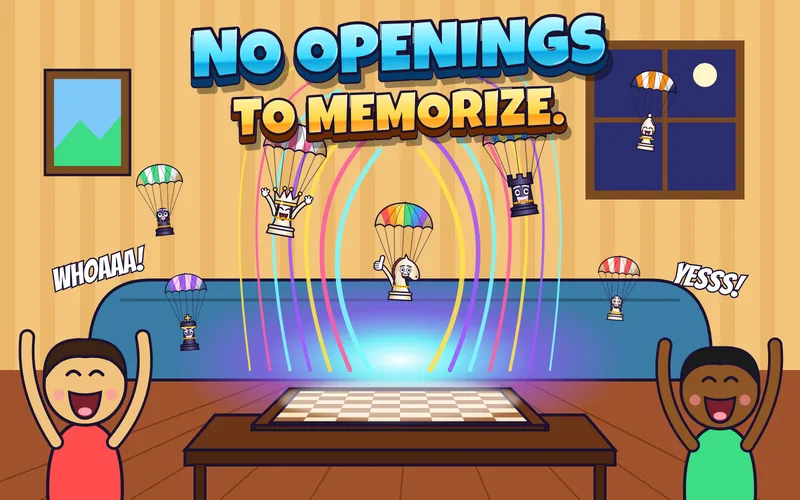
Here, only the two kings are on the board at the start. Each player decides which pieces to bring in, where and when. With so many choices from the very first move, there are no well-known lines to memorize, and you have to think from move one.
How fast the choices multiply
We counted every legal move and drop from the starting position with a computer. Here is how many different games are possible after the first few moves.
| After | Chess | Parachute Chess |
|---|---|---|
| White's first move | 20 | 158 |
| One move each | 400 | 22,960 |
| Three moves (White, Black, White) | 8,902 | 3,346,246 |
The choices don't run out after the opening either. In our engine test games, the player to move had about 45 legal options per turn on average, because any piece still in reserve can land on any empty square of your half.
Skills that show up at the board
- Reading the threats you can't see yet. Every piece in your opponent's reserve could land next move. You have to picture where it could land, not just where the pieces on the board can go.
- Timing. Drop a piece early to take space, or keep it back for the perfect moment. Holding a knight in reserve can be stronger than placing it.
- King safety. Kings start in the corners, and checks can come from anywhere, so guarding your king is a constant puzzle.
- Tactics and planning. Forks, pins, checks and mating attacks all work just as they do in chess, and a chess player's tactical eye carries straight over.
The testing backs it up
In 3,400 games between copies of a strong chess engine:
- White won 55% of the decisive games, against 57% in standard chess. Moving first helps about as much as it does in chess.
- At the slowest setting, 76% of games ended in checkmate, against 28% in standard chess. Draws fell from 72% to 24%.
These are engine games, and human playtesting is the next step. See how we tested →
What we're not claiming
Memory still helps in any game. As more people play, good principles and favorite opening ideas will become known, and experienced players will recognize patterns faster. And chess itself takes far more than memory: strong chess players are also great calculators and planners.
The difference is one of degree. With so many choices from the first move, memorizing long sequences pays off much less in Parachute Chess, and thinking at the board pays off much more.
A good fit for
New players
If you know how the pieces move, you're ready. There's no opening theory to study first.
Chess players
Same pieces and the same tactics, with a fresh puzzle every game and no preparation gap.
Friends and clubs
Use any chess set. Games usually end with a winner, and every one plays out differently.